

How Much Down Payment Do You Need for a UAE Mortgage?
How much down payment do you need for a UAE mortgage? Compare CBUAE LTV limits for UAE nationals and expatriates, see deposit examples and calculate your estimated cash requirement.
Miracle Keys Advisory Team
UAE Mortgage Specialists
Start With the Cash Requirement
How Much Money Do You Need Before Applying?
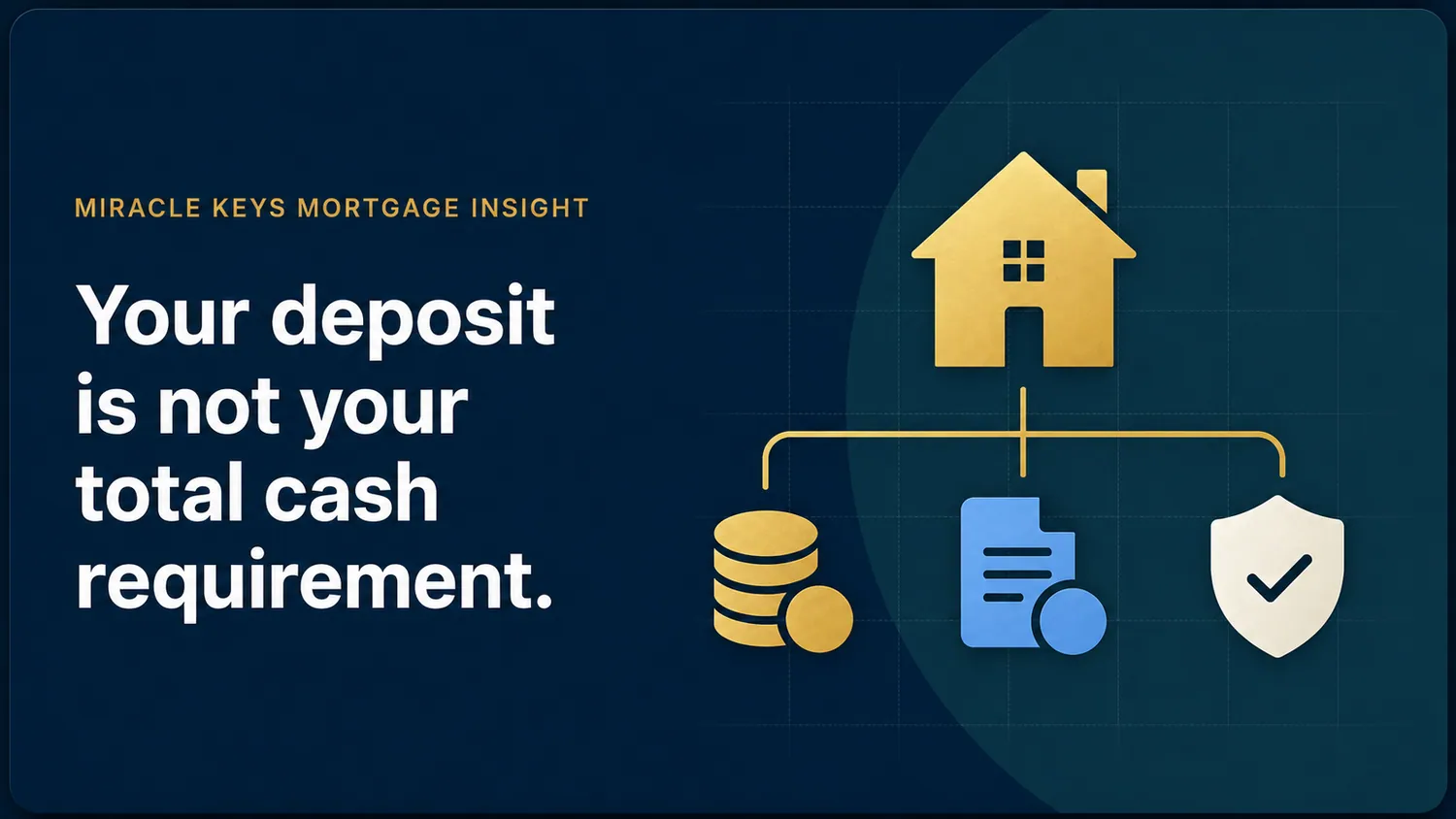
The down payment is the portion of the purchase price funded from the buyer's own money rather than the mortgage. It is usually one of the largest cash requirements in a UAE property transaction, but it is not the only amount that must be available.
A buyer must also consider registration fees, mortgage registration, valuation, bank charges, insurance, professional costs, utility activation and a financial reserve. A technically sufficient deposit can therefore still leave the buyer short of cash at completion.
Our mortgage advisory service is completely FREE.Miracle Keys supports you from the first consultation until mortgage completion and property handover.
Basic Mortgage Structure
What Is a Mortgage Down Payment?
The CBUAE defines a down payment as an upfront payment from the buyer that covers part of the purchase price and reduces the value of the loan against the property. The remaining eligible portion may be financed through the mortgage.
Buyer down payment + Mortgage amount = Purchase price
For example, if a property costs AED 2 million and the bank approves a mortgage of AED 1.6 million, the buyer contributes AED 400,000 toward the price. Completion expenses are added separately.
Shared Financial Risk
Why Do Banks Require a Down Payment?
Borrower commitment
A meaningful equity contribution demonstrates that the buyer has capital invested in the transaction.
Lower lender exposure
The bank finances less than the full property value, reducing the impact of potential price movements.
Regulatory compliance
UAE mortgage lending is subject to maximum loan-to-value limits for different borrower and property categories.
Affordability discipline
A lower mortgage generally means lower repayments and less total interest, although approval still depends on income and liabilities.
A larger deposit may improve the choice of products or reduce monthly payments, but it does not guarantee mortgage approval. The bank must still assess affordability, credit conduct, property eligibility and source of funds.
Core Mortgage Ratio
Understanding Loan-to-Value
Loan-to-value, usually shortened to LTV, measures the mortgage amount against the lender's accepted property value. The accepted value may be influenced by the bank valuation, not only the agreed purchase price.
LTV = Mortgage Amount ÷ Property Value × 100 AED 1.6m mortgage ÷ AED 2m value = 80% LTV
A higher LTV means the bank is financing more of the property and the buyer contributes less. A lower LTV means the buyer contributes more capital and borrows less.
Valuation risk matters. If the bank valuation is lower than the purchase price, the buyer may need to contribute more cash than expected because the lender can calculate finance using the lower accepted value.
Current CBUAE Framework
UAE Mortgage Down Payment Requirements
The following figures apply to a qualifying first house or owner-occupied property under the current CBUAE mortgage regulations. Each borrower can claim only one property under this category, and lenders may apply stricter internal criteria.
Buyer category | Property value | Maximum LTV | Illustrative minimum down payment |
|---|---|---|---|
UAE national — first owner-occupied property | AED 5m or less | 85% | 15% |
UAE national — first owner-occupied property | Above AED 5m | 75% | 25% |
Expatriate — first owner-occupied property | AED 5m or less | 80% | 20% |
Expatriate — first owner-occupied property | Above AED 5m | 70% | 30% |
Second homes and investment properties
The CBUAE framework applies lower maximum LTVs to second and subsequent houses or investment properties: 65% for UAE nationals and 60% for expatriates, regardless of property value. This implies buyer contributions of at least 35% and 40% respectively, before additional costs.
Off-plan property
Off-plan finance is treated differently under the CBUAE framework and is also affected by project eligibility, construction stage, developer arrangements and lender policy. Buyers should not assume that ready-property LTV limits automatically apply to an off-plan purchase.
Maximum LTV is not a guaranteed approval.A lender can approve a lower amount based on income, liabilities, credit profile, property type, valuation, age, employment or internal policy.
Illustrative Cash Contributions
Down Payment Examples
Expatriate — first owner-occupied property up to AED 5 million
Purchase price | Illustrative 80% mortgage | Illustrative 20% down payment |
|---|---|---|
AED 1,000,000 | AED 800,000 | AED 200,000 |
AED 2,000,000 | AED 1,600,000 | AED 400,000 |
AED 3,000,000 | AED 2,400,000 | AED 600,000 |
AED 5,000,000 | AED 4,000,000 | AED 1,000,000 |
UAE national — first owner-occupied property up to AED 5 million
Purchase price | Illustrative 85% mortgage | Illustrative 15% down payment |
|---|---|---|
AED 1,000,000 | AED 850,000 | AED 150,000 |
AED 2,000,000 | AED 1,700,000 | AED 300,000 |
AED 3,000,000 | AED 2,550,000 | AED 450,000 |
AED 5,000,000 | AED 4,250,000 | AED 750,000 |
These examples assume the property valuation supports the purchase price and the borrower qualifies for the maximum LTV. They exclude all registration, bank and completion costs.
Overseas Buyer Deposits
What About Non-Resident Buyers?
Non-resident mortgage availability differs significantly by lender. The maximum finance can depend on nationality, country of residence, currency and source of income, property location, property type, loan size and whether the applicant is salaried, self-employed or retired.
Because lender appetite changes and there is no single product suitable for every overseas buyer, non-residents should obtain a personalised assessment before reserving a property. A larger deposit is often required than for a resident owner-occupier, but the exact amount should be confirmed against current lender policy.
Do not rely on a universal online percentage.For non-residents, the correct deposit is the result of the applicant's profile, selected bank, accepted property and current product criteria.
Deposit Is Only One Component
Additional Buying Costs to Budget For
Property registration
Government and administrative charges depend on the emirate and transaction.
Mortgage registration
Dubai Land Department currently lists 0.25% of the mortgage value for an ordinary mortgage, plus applicable title and administrative charges.
Property valuation
The bank appoints an approved valuer before final mortgage approval.
Bank processing
Arrangement or administration fees vary by product and lender.
Insurance
Life and property cover may be required by the lender.
Professional support
Conveyancing, legal advice, translation or power-of-attorney costs may apply.
Utilities and moving
Deposits, activation, movers, cleaning and access permits should be included.
Furniture and reserve
Keep funds for furnishing, repairs, service charges and unexpected expenses.
For a fuller transaction-cost breakdown, link this section to the Miracle Keys guide: Hidden Costs of Buying Property in Dubai.
Deposit Planning
How to Build Your Mortgage Deposit
Set a target property range. Estimate the deposit and buying costs before beginning viewings.
Automate monthly savings. Move money into a separate deposit account immediately after income is received.
Reduce expensive debt. Lower card and personal-loan balances can improve both savings and mortgage affordability.
Use bonuses intentionally. Allocate windfalls to the purchase fund instead of allowing lifestyle spending to absorb them.
Track irregular costs. Annual travel, school, insurance and family commitments should be included in the savings plan.
Protect the deposit from currency risk. Overseas buyers should plan exchange timing and transfer documentation.
Keep source-of-funds records. Retain statements showing how savings accumulated.
Maintain a separate emergency fund. Do not treat every available dirham as part of the deposit.
Avoidable Deposit Errors
Common Down Payment Mistakes
Using all savings for the deposit
This leaves no funds for registration, completion or unexpected ownership costs.
Ignoring the valuation
A lower bank valuation can increase the required buyer contribution.
Assuming every lender offers maximum LTV
Internal policy may result in a lower approved mortgage.
Borrowing the deposit without disclosure
New debt affects affordability and source-of-funds checks.
Waiting until a property is found
Late planning can create pressure during reservation and transfer deadlines.
Confusing deposit with total cash required
The transaction can fail even when the price contribution is available if fees have not been budgeted.
Interactive Planning Tool
UAE Mortgage Down Payment Calculator
Select a buyer category or enter a custom illustrative LTV to estimate the mortgage, deposit and total cash requirement.
UAE national — first owner-occupied property Expatriate — first owner-occupied property UAE national — second/investment property Expatriate — second/investment property Non-resident / custom LTV Illustrative maximum LTV— Illustrative mortgage amount— Estimated down payment— Estimated total cash required— Cash remaining after purchase— Potential funding shortfall—
Illustrative only. The calculator does not determine eligibility or guarantee the maximum LTV. Actual finance depends on valuation, borrower affordability, lender policy, property type and current regulation.
Frequently Asked Questions
UAE Mortgage Deposit FAQs
Not normally under the current first owner-occupier LTV limits for a standard resident expatriate mortgage. Specific structures or special programmes should be checked individually and must still meet regulatory and lender requirements.
Any borrowed funds create an additional liability and can reduce mortgage affordability. The source must be disclosed and acceptable to the lender.
No. Registration, mortgage, valuation, bank, insurance and setup costs should be budgeted separately.
Gifted funds may be considered by some lenders, but evidence of the gift, source of funds and relationship may be required.
Yes. Lenders and transaction parties may request statements and supporting documents for savings, gifts, asset sales, business income or overseas transfers.
Generally, yes. Borrowing less normally reduces the monthly payment and total interest, assuming the rate and term remain the same.
The lender may calculate finance using the lower accepted value, which can increase the buyer's cash contribution.
This depends on ownership, legal and lender requirements. Clear source-of-funds evidence and appropriate company documentation may be needed.
Potentially, subject to property value, outstanding balance, affordability and lender criteria at the time of refinancing.
Yes. Our mortgage advisory service is completely free from your first consultation until mortgage completion and property handover.
Related Guides
Continue Your UAE Mortgage Research
Buying GuideFirst-Time Buyer's Guide to UAE Mortgages
Application GuideMortgage Pre-Approval Explained
Purchase BudgetHidden Costs of Buying Property in Dubai
New DevelopmentOff-Plan Mortgage Guide
International BuyersNon-Resident Mortgage Guide
Rate OutlookUAE Mortgage Interest Rate Forecast
Official Sources & Publishing Note
Verify Current Rules Before Publication
Central Bank of the UAE: Regulations Regarding Mortgage Loans
CBUAE Rulebook: Article 3 — Important Ratios
Dubai Land Department: Mortgage Registration
Regulations, lender criteria, property eligibility and fees can change. Recheck all figures immediately before publishing. This article is general educational information and is not a mortgage offer, credit decision, legal advice or investment advice.