What Happens on Property Transfer Day in Dubai?
A practical guide to Dubai property transfer day: what happens at the Real Estate Registration Trustee Centre, what documents are checked, how mortgage registration fits in, and when the electronic title deed is issued.
Miracle Keys Advisory Team
UAE Mortgage Specialists
A good transfer day is prepared days or weeks before the appointment
For a mortgaged buyer, transfer day is the final execution of work that should already be substantially complete: borrower approval, property valuation, final bank requirements, sale documentation and the completion payment structure.
Before the appointment, the relevant property documents should be ready, the developer e-NOC obtained where applicable, the mortgage prepared for completion and the required payment instruments or approved payment arrangements confirmed.
For a financed purchase, the bank's mortgage-registration requirements also need to be ready. DLD's mortgage-registration process allows the financing bank to prepare and submit mortgage documents electronically, while trustee-centre processing is also available.
A smooth transfer day is mostly created before transfer day. The appointment is where the prepared transaction is registered — not where missing finance, missing documents or unresolved liabilities are supposed to be fixed.
For a standard sale, the trustee centre is where the prepared transaction becomes a registered one
Dubai Land Department provides its standard property-sale registration service through Real Estate Registration Trustee Centres.
The contracting parties — or legally authorised representatives where applicable — proceed through the registration process. The trustee checks the required documents, enters the transaction details and processes the sale through DLD's system.
DLD also offers a separate digital Dubai Now route for certain eligible, mortgage-free freehold units, but that service has specific conditions. A bank-financed purchase should therefore not be assumed to follow the same digital-only path.
What transfer day looks like, step by step
The parties and the transaction are confirmed
The buyer and seller — or authorised representatives where permitted — enter the trustee registration process against the agreed property transaction.
The transfer file is checked
The trustee verifies the required documentation. If something essential is missing or inconsistent, the transaction may need to be resolved before registration can continue.
The transaction is entered into the DLD system
The sale details are recorded and the registration request is processed through the department's system.
The completion money and registration charges are dealt with
The required transaction payments and applicable DLD charges are completed using the approved payment structure for the sale.
The transaction is audited
The registration goes through the required DLD audit or verification before completion.
The registered outputs are issued
For a standard property sale, DLD lists the electronic title deed and relevant electronic outputs among the documents issued after successful registration.
With bank finance, two legal positions need to be recorded: your ownership and the bank's security
A mortgaged transfer is more than a buyer replacing a seller on the title. The buyer becomes the registered owner, while the financing bank's mortgage is registered against the property as security for the facility.
DLD's current mortgage-registration service covers registration in favour of the financing entity. Under the online process, the customer prepares the mortgage requirements with the bank, the bank uploads the documents through DLD's mortgage system, the transaction is audited and the outputs are delivered electronically.
DLD currently lists the mortgage-registration fee at 0.25% of the mortgage value, separate from the property-sale registration charge. Additional registration and service-partner charges can apply depending on the transaction route.
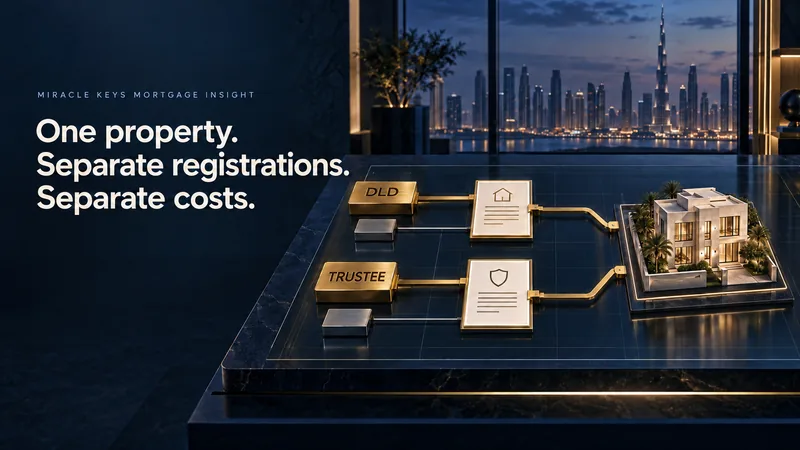
Ownership and mortgage registration are related but separate legal registrations. The buyer becomes the registered owner while the bank's mortgage is recorded as security over the property.
Transfer day is also where separate pots of money finally meet
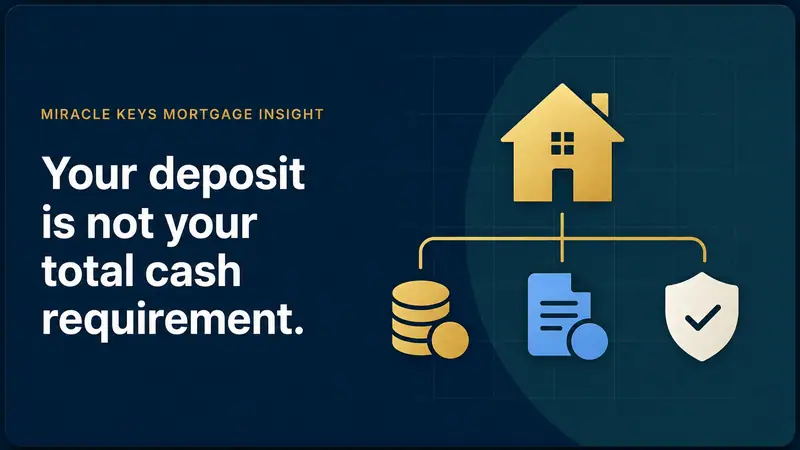
A buyer may think of completion as one payment to the seller. In a mortgaged transaction, the money is usually better understood as several separate amounts, each with a different purpose.
Purchase balance
The remaining amount due to the seller after accounting for deposit, mortgage proceeds and any agreed adjustments.
DLD sale registration
DLD currently lists a total sale-registration fee equal to 4% of the sale value, presented as 2% seller and 2% buyer.
Mortgage registration
For financed purchases, DLD currently charges 0.25% of the mortgage value for mortgage registration.
Trustee & administrative fees
Service-partner, title deed, map, knowledge and innovation charges can apply depending on the transaction.
Bank processing, valuation, insurance or takaful, developer NOC and other third-party costs sit outside these DLD registration charges.
There is no single transfer-day checklist for every Dubai purchase
For individuals using DLD's standard property-sale registration service, DLD currently lists Emirates ID for the seller and buyer — or a valid passport for non-resident foreigners — together with an e-NOC from the developer in applicable freehold areas.
Bank finance adds another document layer. DLD's mortgage-registration requirements include documentation from the mortgagee bank and mortgage contracts, together with identification and other supporting documents where relevant.
This is not a universal transfer-day checklist. Mortgaged resales, company purchases, powers of attorney, provisional registrations and other transaction types can require additional documentation.
Signing the deal is not the same as registering the ownership
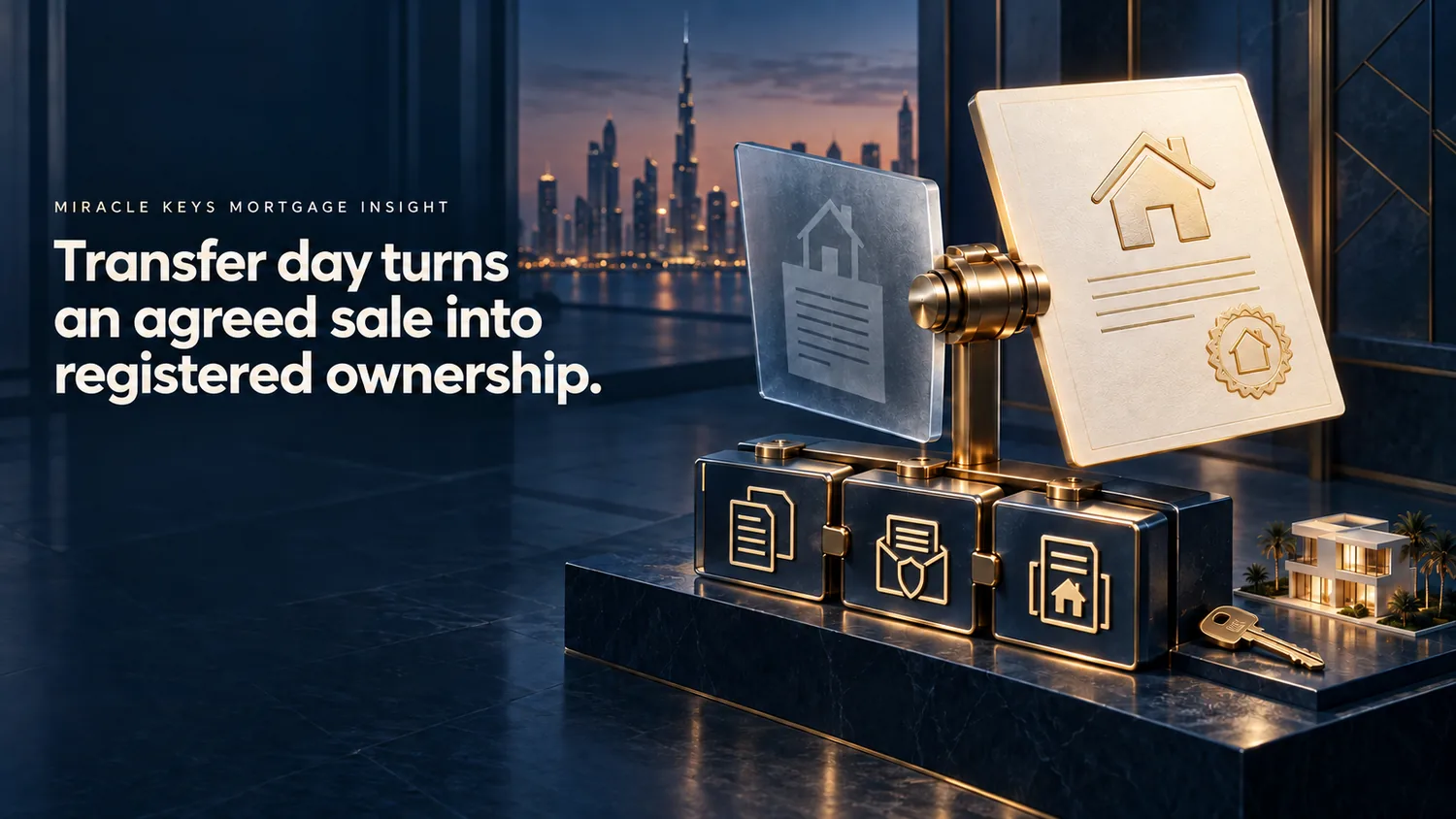
For the title position, the key event is successful registration of the sale through Dubai Land Department. Signing the sale agreement, obtaining mortgage approval or preparing the completion payments are important milestones, but none should be confused with the completed registration itself.
DLD lists an electronic title deed among the issued documents for its standard property-sale registration service. Once the sale has been successfully registered, the title reflects the new ownership position.
For a mortgaged purchase, the bank's mortgage is also recorded against the property as part of the financing structure.
If the seller has a mortgage, there is another bank in the transaction
When the seller's property is already mortgaged, their lender has an existing registered interest that must be dealt with as part of the sale. The transaction is therefore more involved than a straightforward unencumbered transfer.
DLD has a specific service for registering the sale of a mortgaged property. Its published process provides for the seller's bank indebtedness to be dealt with, a mortgage-release certificate to be obtained and the release, sale and new mortgage — where applicable — to be completed in sequence.
DLD's current requirements for this process include a bank liability letter and manager cheques allocated to the existing lender or developer, the seller where a balance remains, and DLD fees.
When the seller has an existing mortgage, “transfer day” can be the final step in a liability-settlement process that started earlier.
If transfer day stalls, the cause often started earlier
DLD's published processing time for a ready standard sale is relatively short. That does not mean a mortgage transaction can be prepared in the same amount of time.
Missing or inconsistent documents, an unresolved seller liability, an expired or unavailable NOC, incorrect payment arrangements or unfinished bank completion requirements can all interrupt the final stage.
The trustee appointment is the visible end of the process. The less visible work — aligning the bank, buyer, seller, property documents and money — is what makes that appointment straightforward.
Once the transfer completes, the transaction changes from buying a property to owning one
After successful registration, retain the electronic title deed, registration outputs, payment receipts and mortgage documentation.
Depending on the property and transaction, the buyer may then need to complete post-transfer practical matters such as developer or building records, utilities, community access and handover arrangements.
The mortgage itself also moves into its normal servicing stage: instalments, insurance or takaful requirements and the lender's ongoing account administration now apply under the facility terms.
The best transfer day is uneventful
By this stage, there should be very little left to decide. The lender has been selected, the borrower and property have cleared the required approvals, the valuation has been dealt with, the cash requirement is understood and the completion sequence has been coordinated.
That is what good mortgage preparation looks like. Transfer day is not supposed to be dramatic; it is supposed to convert a prepared transaction into registered ownership.
Arrive with the finance, documents, payment structure and parties aligned — and let transfer day do what it is meant to do: complete the purchase.
Dubai property transfer day FAQs
Where does a normal Dubai property transfer take place?
DLD provides standard property-sale registration through Real Estate Registration Trustee Centres. Certain transactions may have other eligible channels.
Do the buyer and seller both need to attend?
DLD's standard sale-registration process is between the contracting parties or their legally authorised representatives. The exact attendance requirements should be confirmed for the specific transaction.
How long does the transfer itself take?
DLD currently publishes a 25-minute service time for standard property-sale registration once the transaction is ready for processing. This is not the total time required for mortgage approval, bank coordination or preparation.
When do I receive the title deed?
DLD lists an electronic title deed among the issued outputs for a successfully registered standard property sale.
What happens to the bank mortgage at transfer?
The lender's mortgage is registered in favour of the financing entity. DLD supports mortgage registration through its online mortgage system and through Real Estate Registration Trustee Centres.
What if the seller already has a mortgage?
A separate liability-settlement and mortgage-release sequence is required before the sale and any new mortgage can be completed in the required order.
Is transfer day the same as property handover?
Not always. Legal registration of ownership and practical handover of keys, access cards or possession can be closely linked but are distinct steps depending on the transaction.