

UAE Mortgage Interest Rate Forecast
Explore the UAE mortgage interest-rate outlook for 2026, including CBUAE policy, EIBOR, fixed and variable mortgages, forecast scenarios and repayment impacts.
Miracle Keys Advisory Team
UAE Mortgage Specialists
The Cost of Borrowing
Why Mortgage Interest Rates Matter
The interest rate affects the monthly mortgage payment, the total cost of borrowing and the size of loan a household can comfortably support. Even a modest difference in rate can have a meaningful effect when applied to a large balance over many years.
No bank, broker or economist can guarantee the future path of mortgage rates. The useful approach is to understand the forces that influence pricing, compare products on a like-for-like basis and test whether the mortgage remains affordable under less favourable conditions.
Miracle Keys provides completely FREE mortgage advice.Our service remains free from the first consultation until mortgage completion and property handover.
July 2026 Snapshot
The Current UAE Interest-Rate Environment
The CBUAE maintained its Base Rate at 3.65% on 17 June 2026. At its June meeting, the US Federal Reserve maintained the federal funds target range at 3.50%–3.75%. These policy settings matter because the UAE dirham is pegged to the US dollar and UAE monetary conditions generally move closely with US policy.
The advertised mortgage rate offered to an individual borrower is not identical to the CBUAE Base Rate. Banks also consider EIBOR, funding costs, liquidity, product design, operating expenses, credit risk, property type, customer profile and competitive strategy.
Do not publish a universal “market mortgage rate”. Offers can differ by bank, fixed period, salary transfer, loan size, property type, applicant profile and promotional conditions.
Pricing Chain
How UAE Mortgage Rates Are Determined
US Federal Reserve→ CBUAE policy→ EIBOR & funding costs→ Bank pricing→ Mortgage payment
External influences
- US monetary policy and financial-market expectations
- Global inflation and economic growth
- Energy prices and geopolitical risk
- International bank funding and liquidity conditions
UAE and lender-specific influences
- CBUAE policy settings and domestic liquidity
- EIBOR movements across different tenors
- Competition among UAE banks
- Borrower credit risk and affordability
- Property type, valuation and loan-to-value
- Fixed-rate duration and product features
Variable-Rate Benchmark
Understanding EIBOR
EIBOR—the Emirates Interbank Offered Rate—is a reference rate for UAE dirham funding in the domestic money market. It is also used in financial products, including many variable-rate mortgages.
EIBOR benchmark + bank margin = variable mortgage rate
A product might reference a one-month, three-month or other EIBOR tenor. The applicable benchmark is reviewed at the reset frequency defined in the mortgage agreement. If the benchmark rises, the rate and payment can increase. If it falls, the borrower may benefit, subject to the contract, margin, floor and repricing rules.
Check for a minimum rate or floor.A falling EIBOR does not always reduce the mortgage below the contractual minimum rate.
Product Structure
Fixed Versus Variable Mortgage Rates
Feature | Fixed rate | Variable rate |
|---|---|---|
Payment stability | Stable during the stated fixed period | Can change at each reset |
Protection from increases | Yes, during the fixed period | No |
Benefit from falling benchmarks | Not until repricing or refinancing | Potentially, subject to terms and floors |
Budgeting | More predictable | Requires greater payment flexibility |
After introductory period | Usually reverts to another pricing formula | Continues under the agreed benchmark formula |
A hybrid product may fix the rate for an introductory period and then move to a variable formula. The initial rate is therefore only one part of the comparison. Review the reversion margin, benchmark, floor, fees and expected ownership period.
Read the complete Fixed vs Variable Mortgage Guide →
Economic Signals
What Could Move UAE Mortgage Rates During 2026?
Inflation
Persistent inflation can delay policy easing, while sustained disinflation can support lower rates.
US labour and growth data
Strong demand may keep policy restrictive; weaker activity may increase the case for cuts.
Energy and geopolitics
Supply shocks can affect inflation expectations and financial-market risk.
Bank competition
Lenders may alter margins or promotions even when the policy rate is unchanged.
EIBOR expectations
Money-market pricing can move before or between central-bank decisions.
Borrower profile
Income, employer, deposit, credit and property quality influence the final customer rate.
Not a Guaranteed Prediction
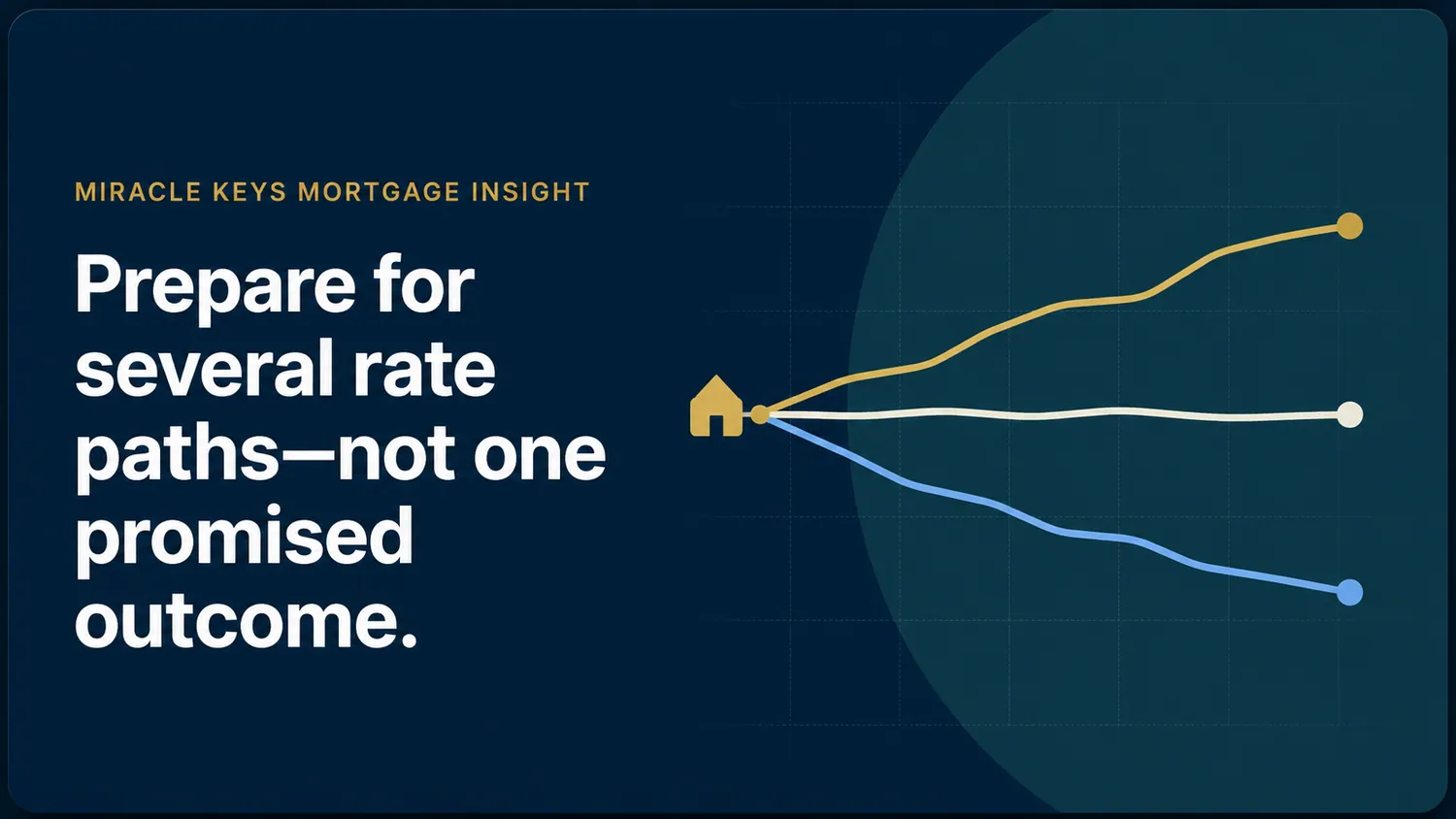
Three UAE Mortgage-Rate Scenarios for 2026
Scenario A
Rates remain broadly stable
This could occur if inflation continues to moderate only gradually and central banks prefer to wait for clearer evidence before changing policy.
Borrower implication: Fixed and variable payments may remain near current levels, while bank competition produces selective offers.
Scenario B
Rates decline gradually
This may become more likely if inflation eases sustainably, growth softens and the Federal Reserve begins or continues measured policy reductions.
Borrower implication: Variable mortgages may reprice lower over time, while new fixed offers could become more competitive.
Scenario C
Rates move higher
A renewed inflation shock, stronger demand, energy disruption or tighter market conditions could keep rates elevated or lead to additional restraint.
Borrower implication: Variable payments could rise and fixed-rate certainty may become more valuable.
Planning conclusion:Build the mortgage around affordability under more than one scenario. Do not structure a purchase that only works if rates fall quickly.
Repayment Sensitivity
How Rate Changes Affect Monthly Payments
The following example uses an AED 1,500,000 repayment mortgage over 25 years. It assumes the stated rate remains constant for the entire term and excludes insurance and fees.
Illustrative annual rate | Estimated monthly payment | Estimated total repayment |
|---|---|---|
3.99% | AED 7,909 | AED 2,372,782 |
4.49% | AED 8,329 | AED 2,498,693 |
4.99% | AED 8,760 | AED 2,628,034 |
5.49% | AED 9,202 | AED 2,760,707 |
Actual mortgages may have an introductory fixed period followed by variable pricing, so lifetime outcomes can differ materially from a constant-rate illustration.
Purchase Timing
Should Buyers Wait for Lower Mortgage Rates?
Potential advantages of waiting
- Borrowing costs may decline
- Additional deposit savings may accumulate
- The buyer has more time to improve credit or reduce debt
Potential costs of waiting
- Suitable property prices may rise
- Preferred inventory may disappear
- Rental payments or missed rental income continue
- Future rates may not decline as expected
The right decision depends on personal affordability, deposit strength, ownership horizon and the quality of the property opportunity. A buyer who can comfortably afford the payment, maintain reserves and choose a suitable product may not benefit from waiting indefinitely for a “perfect” rate.
Investment Property
What Rate Changes Mean for Property Investors
Investors should assess the mortgage as part of the complete property cash-flow model. The relevant comparison is not only the interest rate, but the relationship between rent, service charges, vacancy, maintenance, management, financing costs and expected holding period.
Cash-flow resilience
Stress-test whether rental income can support higher payments and periods without a tenant.
Leverage discipline
Higher leverage can improve capital efficiency but also magnifies financing and valuation risk.
Refinancing option
A future buyout may reduce costs if better products become available, but switching fees must be recovered.
Exit horizon
A short intended holding period can make upfront mortgage and refinancing costs more significant.
Current Homeowners
What Existing Mortgage Holders Can Do
Existing borrowers do not need to wait passively for the market. They can review the current balance, rate, fixed-period expiry, reversion formula, settlement charge and remaining term.
- Request a retention offer from the current bank
- Compare a mortgage buyout from another lender
- Consider fixing a variable mortgage where suitable
- Review whether a term adjustment supports cash flow
- Assess equity release only where the additional borrowing has a clear purpose
Read the Mortgage Buyout & Refinancing Guide →
Avoidable Errors
Common Mortgage-Rate Mistakes
Waiting forever for the lowest rate
The property market and personal circumstances may change before the forecast is realised.
Choosing only by headline pricing
Processing fees, insurance, valuation, reversion pricing and settlement terms matter.
Ignoring rate stress
A variable mortgage should remain manageable if the benchmark rises.
Using the maximum approval
Bank eligibility is not the same as comfortable household affordability.
Not reviewing fixed expiry
Allow time to compare retention and buyout options before reversion.
Extending the term automatically
A lower payment can produce substantially more lifetime interest.
Borrower Checklist
10 Mortgage-Rate Tips for UAE Buyers
Compare total borrowing cost. Include rates, margins, fees, insurance and expected reversion.
Identify the product structure. Confirm whether the mortgage is fixed, variable or hybrid.
Stress-test the payment. Model higher rates before committing.
Maintain a cash reserve. Do not use every available dirham for the deposit.
Review refinancing periodically. Compare options before the fixed period expires.
Read the benchmark rules. Understand the EIBOR tenor, reset timing, margin and floor.
Obtain pre-approval. Establish affordability before signing a binding property commitment.
Match the product to the ownership horizon. A short fixed period may not suit every buyer.
Do not borrow solely on a rate forecast. The mortgage should work under realistic alternative outcomes.
Use a like-for-like comparison. Compare the same balance, term and repayment method.
Interactive Planning Tool
UAE Mortgage Rate Calculator
Calculate an estimated repayment and compare it with a second interest rate.
Payment at primary rate— Payment at comparison rate— Monthly difference— Primary-rate total interest—
Illustrative repayment calculation only. It assumes a constant rate and standard monthly amortisation. Actual bank calculations, repricing, insurance and fees may differ.
Frequently Asked Questions
UAE Mortgage Interest-Rate FAQs
They may decline, remain stable or rise. The outcome depends on inflation, Federal Reserve policy, CBUAE decisions, EIBOR and bank funding conditions. No forecast is guaranteed.
The decision should be based on affordability, deposit strength, reserves, ownership horizon and property suitability—not only on a rate prediction.
They provide greater payment certainty during the fixed period. They do not eliminate reversion, settlement or refinancing considerations.
EIBOR is a UAE dirham money-market benchmark used in many financial products, including variable-rate mortgages.
The reset frequency is defined in the mortgage agreement and depends on the referenced benchmark tenor and product terms.
Potentially, subject to eligibility, valuation, settlement charges and whether the savings exceed the switching costs.
Some lenders offer fixed pricing for a defined period, but the offer validity, completion deadline and post-fixed pricing should be reviewed carefully.
They can be. Non-resident products may have different pricing, deposits, property criteria and documentation requirements.
No. Customer mortgage pricing also reflects EIBOR, bank margins, funding costs, product design and applicant risk.
Yes. Our advisory service is completely free from your first consultation until mortgage completion and property handover.
Related Guides
Continue Your Mortgage Research
Rate StructureFixed vs Variable Mortgage
Existing BorrowersMortgage Buyout & Refinancing
Application GuideMortgage Pre-Approval Explained
Buying GuideFirst-Time Buyer's Mortgage Guide
International BuyersNon-Resident Mortgage Guide
New DevelopmentOff-Plan Mortgage Guide
Official Sources & Publishing Note
Verify Rates Before Publication
CBUAE: Base Rate maintained at 3.65% — 17 June 2026
CBUAE: Current and historical EIBOR rates
US Federal Reserve: June 2026 FOMC statement
CBUAE: Quarterly Economic Review — June 2026
Rates, EIBOR fixings, product margins and economic forecasts can change. Update the market strip, publication date and source references immediately before publishing. This content is educational and is not a guaranteed rate forecast, investment recommendation or credit offer.