
Fixed vs Variable Mortgage: Which Is Better in the UAE?
Compare fixed and variable mortgages in the UAE in 2026. Learn how EIBOR, fixed periods, bank margins, repricing and risk affect your mortgage choice.
Miracle Keys Advisory Team
UAE Mortgage Specialists
Current UAE Rate Environment
Why Mortgage Structure Matters in 2026
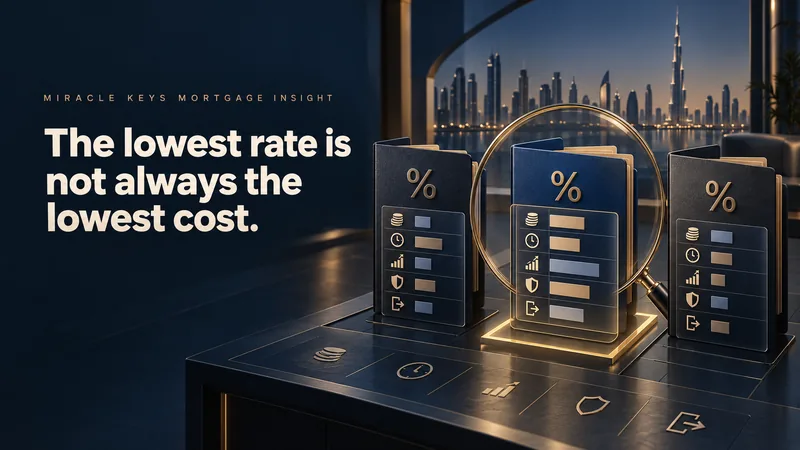
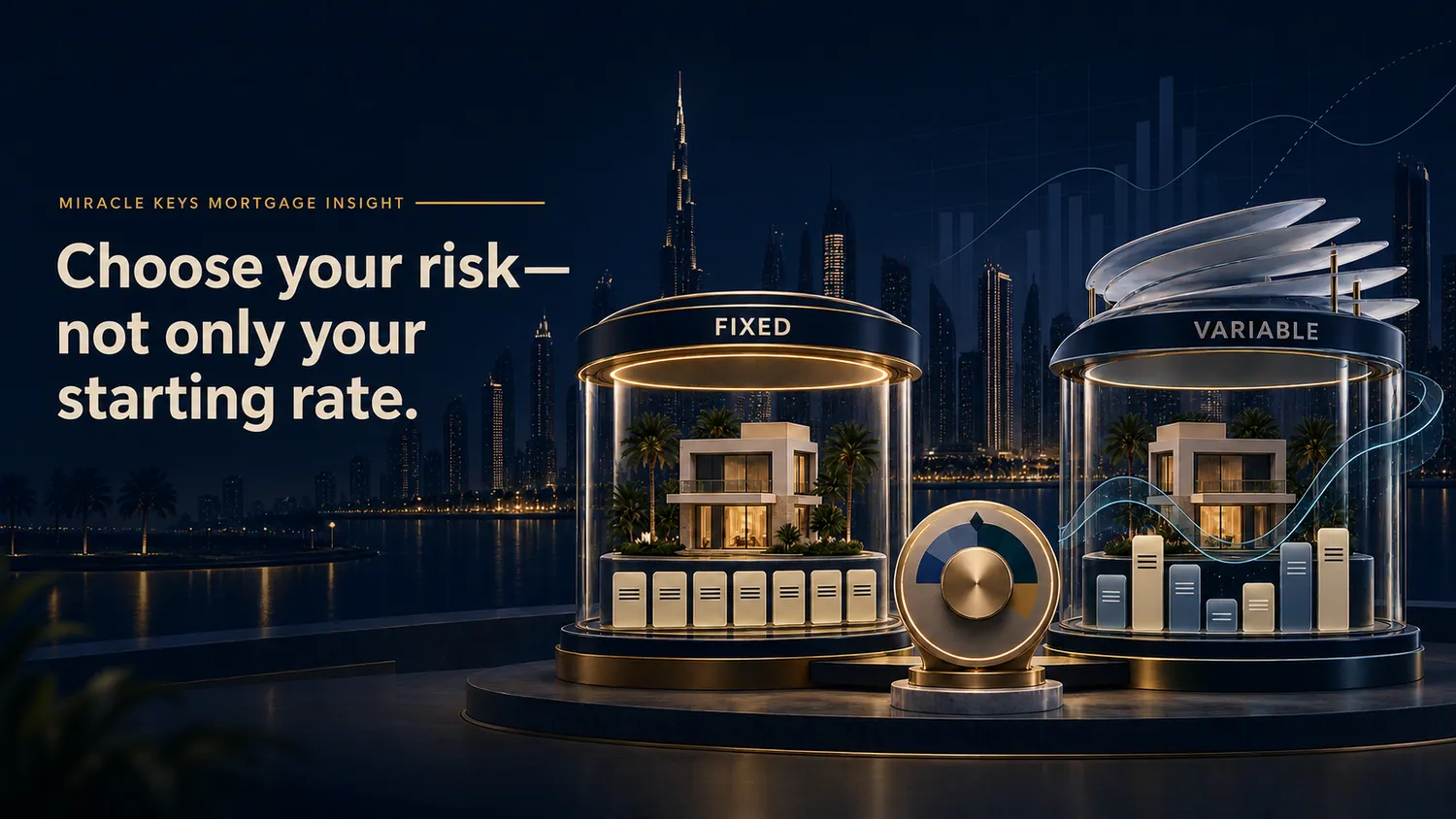
Choosing between a fixed and variable mortgage is not simply a question of finding the lowest advertised rate. The structure determines how predictable your payment will be, how quickly market-rate changes reach your mortgage and how much risk you carry over the life of the loan.
The Central Bank of the UAE maintained its Base Rate at 3.65% in June 2026. The CBUAE also publishes EIBOR, the Emirates Interbank Offered Rate, which is commonly used as a benchmark in variable-rate lending. An official CBUAE rate page showed overnight EIBOR at approximately 3.496% on 2 July 2026, although different EIBOR tenors can carry different rates.
Mortgage pricing is not identical to the CBUAE Base Rate or EIBOR. A bank normally adds its own margin, and the final offer depends on the applicant's income, employment profile, down payment, loan-to-value ratio, property, salary transfer and overall credit assessment.
2026 market takeaway:Rates are below their recent peak, but borrowers should not assume the next move will automatically be lower. The right mortgage should remain affordable under more than one rate scenario.
Dubai's property market has also remained highly active. Dubai Land Department reported AED 252 billion of real-estate transactions during Q1 2026, up 31% in value year on year. Strong transaction activity means buyers are comparing products in an environment where both property price and financing quality matter.
Fixed Mortgage
What Is a Fixed-Rate Mortgage?
A fixed-rate mortgage keeps the agreed interest or profit rate unchanged for a specified introductory period. In the UAE, fixed periods commonly range from one to five years, although product structures vary by bank.
During the fixed period, the borrower's payment is usually predictable, assuming the loan balance and repayment schedule do not change. At the end of the fixed period, the mortgage normally moves to the reversion formula stated in the facility agreement. That formula may be linked to EIBOR plus a bank margin, or to another bank-defined rate subject to the contract.
Advantages
Why borrowers choose fixed
- Predictable monthly instalments during the fixed period.
- Protection if benchmark rates rise.
- More straightforward household budgeting.
- Reduced short-term interest-rate anxiety.
Limitations
What to review carefully
- The initial rate may not be the lowest available.
- You may not benefit immediately if market rates fall.
- The post-fixed reversion rate can be materially higher.
- Early settlement or transfer conditions may apply.
A fixed rate buys certainty for a limited period. It does not fix the mortgage for its entire 20- or 25-year term unless the agreement explicitly says so. Miracle Keys Mortgages
Variable Mortgage
What Is a Variable-Rate Mortgage?
A variable mortgage changes in line with a benchmark or lender pricing formula. In the UAE, many variable products use an EIBOR tenor plus a fixed bank margin. The mortgage agreement states how often the rate resets and which benchmark applies.
Variable mortgage rate = EIBOR + bank marginExample only: 3-month EIBOR plus a contractual bank margin.
If the benchmark falls, the borrower's rate may decline at the next reset, subject to any contractual floor. If it rises, the monthly instalment or repayment allocation can increase. The exact mechanism should be confirmed in the bank's key facts statement and facility letter.
Advantages
Why borrowers choose variable
- Potential benefit when market rates decline.
- Some products begin with competitive pricing.
- Suitable for borrowers comfortable with rate movement.
- May suit a planned short or medium holding period.
Limitations
What to review carefully
- Monthly payments can increase.
- Budgeting is less predictable.
- A floor rate may restrict the benefit of falling EIBOR.
- The reset tenor and timing can affect how quickly changes apply.
Side-by-Side Comparison
Fixed vs Variable Mortgage in the UAE
Feature | Fixed Mortgage | Variable Mortgage |
|---|---|---|
Rate movement | Unchanged during the agreed fixed period | Moves according to the benchmark and reset schedule |
Payment stability | High during the fixed period | Lower because instalments can rise or fall |
Benefit if rates fall | Usually delayed until the fixed period ends or refinancing occurs | Potentially received at the next reset, subject to the contract |
Protection if rates rise | Yes, during the fixed period | No; the borrower remains exposed |
Budgeting | Easier for households needing certainty | Requires a larger affordability buffer |
Key risk | Reversion rate after the fixed period | Rate and payment increases during the loan |
Best suited to | Risk-conscious buyers and first-time owners | Rate-tolerant borrowers with financial flexibility |
Illustrative Payment Comparison
How a Rate Change Can Affect Monthly Payments
The following example is for education only and is not a current bank offer.
Property priceAED 1,500,000 DepositAED 300,000 Mortgage amountAED 1,200,000 Loan term25 years Illustrative fixed rate4.00% Illustrative variable rate4.75%
At 4.00%, the estimated monthly repayment is approximately AED 6,334. At 4.75%, it is approximately AED 6,842. The difference is around AED 508 per month, before insurance and fees.
If the variable rate later rose to 5.75%, the estimated repayment would increase to approximately AED 7,548 per month. This illustrates why a variable-rate borrower should retain a meaningful affordability buffer.
Important: Mortgage payments depend on the exact amortisation method, rate-reset date, remaining balance and lender terms. Figures above are rounded illustrations only.
Choosing the Right Structure
Which Mortgage Is Better for You?
A fixed mortgage may suit you when:
- You are buying your first home and want payment certainty.
- Your household budget has limited room for rate increases.
- You expect to remain in the property through the fixed period.
- You prefer certainty even if the initial price is not the absolute lowest.
- You believe rates may remain stable or rise.
A variable mortgage may suit you when:
- You have sufficient disposable income to absorb higher payments.
- You understand EIBOR and the loan's reset mechanism.
- You expect rates to decline and accept that the forecast may be wrong.
- You may sell, settle or refinance within a shorter period.
- You value flexibility more than short-term payment certainty.
Decision rule:Do not choose a variable mortgage merely because the initial payment is lower. Choose it only if the payment remains manageable after a realistic rate increase.
Common UAE Product Structure
Most “Fixed” Mortgages Are Hybrid Mortgages
Many UAE mortgage products are effectively hybrid loans. They begin with a fixed period and then convert to variable or reversion pricing. This makes the post-fixed formula one of the most important figures in the entire offer.
Before accepting a mortgage, review:
- The fixed-rate duration.
- The rate after the fixed period.
- The EIBOR tenor used after reversion.
- The bank margin added to EIBOR.
- Any minimum or floor rate.
- The reset frequency.
- Early settlement and bank-transfer charges.
- Life and property insurance costs.
A product with a very low introductory rate can become expensive after reversion. Conversely, a slightly higher introductory rate may provide a more competitive long-term formula. The total package matters more than one headline number.
Expert Mortgage Tips
Seven Questions to Ask Before Choosing
1. What is the reversion rate?
Ask for the exact formula that applies after the fixed period.
2. Which EIBOR tenor applies?
One-month, three-month and other tenors can behave differently.
3. Is there a floor?
A floor can limit how much you benefit when benchmark rates fall.
4. How often does it reset?
Reset frequency determines how quickly rate movements affect payments.
5. What are the full fees?
Compare processing, valuation, insurance, settlement and transfer charges.
6. Can you refinance?
Understand the cost and practical requirements of switching banks later.
7. What is your stress-tested payment?
Calculate affordability at least two percentage points above the initial rate.
Interactive Planning Tool
Mortgage Payment Stress Test
Enter a mortgage amount, term and two rates to compare approximate monthly repayments.
Select your figures and compare the estimated repayments. Frequently Asked Questions
Fixed and Variable UAE Mortgages
Neither is always cheaper. A variable product may cost less if rates fall, but more if rates rise. A fixed product provides certainty during the fixed period, although its reversion rate must be reviewed.
EIBOR is the Emirates Interbank Offered Rate. It is a UAE Dirham benchmark published for several tenors and is commonly used in variable-rate loan pricing.
Usually not. Many mortgages are fixed only for an introductory period, commonly between one and five years, and then move to a reversion or variable rate.
Potentially, either through an internal product change or refinancing with another bank. Eligibility, fees and settlement conditions apply.
Many first-time buyers value the predictability of a fixed period. However, the correct option depends on income stability, savings, expected ownership period and the post-fixed pricing formula.
Yes. Our advisory service is completely free from the first consultation until mortgage completion and property handover.
Related Guides
Continue Your Mortgage Research
Property GuideShould You Buy or Rent in Dubai?
Application GuideMortgage Pre-Approval Explained
Buyer GuideFirst-Time Buyer Mortgage Guide
RefinancingMortgage Buyout and Refinancing
Sources and Market References
Data Used in This Guide
- Central Bank of the UAE, Base Rate announcement, 17 June 2026.
- Central Bank of the UAE, EIBOR rates and methodology.
- Dubai Land Department, Q1 2026 real-estate transaction update.
Rates and products change regularly. Replace or refresh market figures before future publication updates.