Islamic vs Conventional Mortgage in the UAE
Islamic vs conventional mortgage in the UAE explained clearly: structure, profit vs interest, pricing, ownership mechanics, Takaful, fees, eligibility and what buyers should compare.
Miracle Keys Advisory Team
UAE Mortgage Specialists

The difference is in the contract — not the property
The easiest way to understand the difference is to separate the property from the financing. The home may be identical; the contractual route used to finance it is not.
With a conventional mortgage, the bank advances a loan secured against the property and the borrower repays the principal together with contractual interest.
Islamic home finance is built around a Shari’ah-compliant contract. Depending on the product, that can involve sale, lease or partnership principles, with the institution earning an agreed profit or other return permitted by the approved structure.
“Profit” and “interest” are not interchangeable labels. The contractual basis is different. But once you move from principle to affordability, you still need to understand the monthly payment, pricing after any fixed period, fees, protection costs and settlement terms.
How Islamic home finance works
There is no single Islamic home-finance contract used across the UAE market. The structure depends on the institution and the product it has approved through its Shari’ah governance process.
Property finance can use concepts such as Ijara (lease), Murabaha (cost-plus sale) or partnership-based arrangements. Those names are useful for understanding the principle, but the facility documents matter more: they set out the customer's obligations, the institution's return and what happens during settlement or termination.
Instead of describing the bank's return as conventional interest, Islamic institutions normally use terms such as profit rate or rental/profit payments in accordance with the financing structure.
Miracle Keys does not determine or certify whether a product is Shari’ah-compliant. That responsibility sits within the Islamic financial institution's approved Shari’ah governance framework and supervisory arrangements.
How a conventional UAE mortgage works
A conventional mortgage follows a more familiar lending model. The bank advances funds, takes mortgage security over the property and the borrower repays principal plus interest over the agreed term.
Pricing can be fixed for a defined period, variable from the outset, or hybrid — fixed initially and then linked to a benchmark such as EIBOR plus the bank's contractual margin.
As with Islamic finance, the bank assesses income, liabilities, credit history, the property, valuation and the applicant's ability to repay before approving the facility.
Islamic vs conventional mortgage: the practical comparison
Area | Islamic home finance | Conventional mortgage |
|---|---|---|
Underlying approach | Structured under Shari’ah-compliant financing principles | Interest-bearing loan secured against property |
Bank return | Usually expressed as profit or rental/profit depending on structure | Expressed as interest |
Contract structure | Can involve sale, lease or partnership concepts depending on product | Loan agreement and mortgage security |
Rate structure | Can be fixed or variable and may use an external benchmark under the approved product structure | Can be fixed or variable and may use EIBOR or another stated benchmark |
Protection | May involve Takaful under the product requirements | Typically uses conventional insurance where required |
Affordability | Subject to UAE mortgage regulation and lender underwriting | Subject to UAE mortgage regulation and lender underwriting |
Property valuation | Required according to lender and transaction criteria | Required according to lender and transaction criteria |
Best option | Depends on buyer preference, eligibility, pricing, fees, flexibility and the exact facility terms |
Profit rate and interest rate are not just different labels
In a conventional mortgage, interest is charged under the lending contract. In Islamic finance, the institution's return arises through the approved Shari’ah-compliant transaction and may be expressed as profit, rental or another structure-appropriate return.
That distinction should be respected. At the same time, a homebuyer still has a household budget to manage. The practical comparison therefore has two layers: Is the structure appropriate for you? and Are the commercial terms competitive for your circumstances?
Monthly instalment
What will actually leave your account each month during the fixed and later variable periods?
Pricing after the fixed period
What benchmark and margin or equivalent pricing mechanism applies once the introductory period ends?
Fees and protection costs
Processing, valuation, registration and insurance or Takaful can affect the overall economics.
Exit and settlement terms
Understand the cost and process if you sell, refinance, transfer or settle the facility early.
Can Islamic home finance still be linked to a benchmark?
Yes. The use of a market benchmark for pricing does not, by itself, make an Islamic facility a conventional interest-bearing loan. The underlying contract and the institution's Shari’ah governance remain fundamental.
For the customer's budget, however, benchmark-linked pricing can still create payment movement. If the relevant benchmark rises, the applicable profit or rental calculation may increase at the contractual reset; if it falls, pricing may reduce, subject to the facility terms.
Benchmark-linked does not mean structurally identical. The benchmark may influence pricing in both products, but the underlying contracts and Shari’ah governance of Islamic finance remain different.
Takaful vs conventional insurance
Protection costs are easy to overlook because they sit outside the headline finance rate. Depending on the product, the lender may require cover for the property and/or the customer.
Islamic finance commonly uses Takaful arrangements, while conventional mortgages typically use conventional insurance. The structure differs, but the buyer should still check the actual premium or contribution, what it covers and whether the charge is monthly, annual or otherwise built into the facility.
Islamic finance does not bypass mortgage eligibility rules
Choosing Islamic home finance changes the financing structure; it does not remove the normal mortgage assessment.
The Central Bank of the UAE expressly recognises mortgage finance granted under Shari’ah principles and requires the applicable mortgage regulations to be observed alongside the specific Shari’ah requirements of the financing structure.
So the familiar underwriting questions remain: Is the income acceptable? What existing liabilities does the applicant carry? Does the Debt Burden Ratio work? Is the credit profile satisfactory? Does the required loan-to-value fit? And will the lender accept the property and valuation?
Islamic vs conventional is a financing-structure decision. It is not a way around normal UAE mortgage underwriting.
Who decides whether Islamic home finance is Shari’ah-compliant?
In the UAE, Shari’ah compliance sits within a formal regulatory framework. The Central Bank's Higher Shari’ah Authority establishes relevant rules, standards and general principles and oversees the internal Shari’ah supervision framework of licensed Islamic financial institutions.
Islamic institutions themselves must maintain governance, supervision and compliance mechanisms for their Shari’ah-compliant activities. CBUAE consumer-protection rules also require Islamic institutions to explain the differences between conventional and Islamic products and the contracts on which their products are based.
For a buyer who specifically wants Shari’ah-compliant finance, a better question than “Is this an Islamic mortgage?” is: What is the approved financing structure, how does it work, and what obligations does it create for me?
Which is cheaper: Islamic or conventional?
There is no reliable rule that one route is always cheaper.
An Islamic institution may have the stronger commercial offer for one applicant while a conventional lender may be more competitive for another. Pricing can change with the loan amount, customer segment, salary-transfer arrangement, fixed period, property, benchmark environment and lender appetite.
The only useful answer is applicant-specific: compare the real facilities you are eligible for, on the same loan amount and over the same expected holding period.
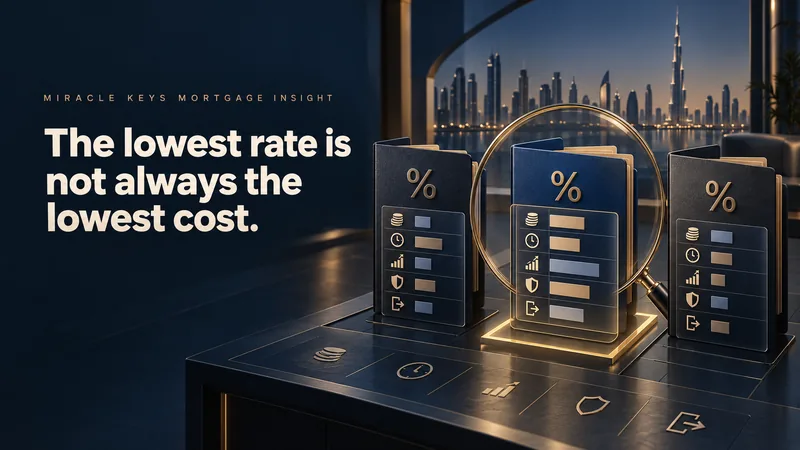
Do not compare only… | Also compare… |
|---|---|
The advertised fixed rate | How long it is fixed and what pricing applies afterwards |
Monthly instalment today | Potential payment after the introductory period |
Processing fee | Total upfront transaction costs |
Profit vs interest terminology | The full contractual structure and financial obligation |
The cheapest headline offer | Eligibility, flexibility, settlement terms and total expected cost |
How should a UAE buyer choose between them?
Start with your financing preference
If Shari’ah compliance is important to you, restrict the comparison to suitable Islamic home finance options from the outset.
Check which lenders fit your profile
Income type, residency, employer or business profile, DBR, credit history and property can narrow the realistic options before pricing is compared.
Compare the whole facility
Review the fixed period, profit or interest rate, later pricing formula, monthly instalment, fees, Takaful or insurance and early-settlement conditions.
Understand the contract you are signing
For Islamic finance, understand the actual Shari’ah-approved structure. For conventional finance, understand the loan and interest-rate mechanics.
Look beyond year one
A mortgage can run for decades. The post-fixed rate and flexibility may matter far more than a small difference in the initial offer.
Same property goal. Different financing architecture.
From the buyer's point of view, much of the journey can look familiar: affordability assessment, pre-approval, property valuation, final documentation and transfer.
The important difference sits underneath that journey — the contract governing the finance, how the institution earns its return and, for Islamic finance, the Shari’ah governance applied to the product.
A strong comparison should therefore do both things properly: respect the structural difference and test the financial outcome.
Islamic vs conventional mortgage FAQs
Is Islamic home finance the same as a conventional mortgage?
No. Islamic home finance uses Shari’ah-compliant contractual structures rather than a conventional interest-bearing loan. Both can finance a property and both remain subject to applicable UAE mortgage regulation and lender underwriting.
Is Islamic home finance interest-free?
It should not be described simply as free finance. Islamic home finance can include a profit rate, rental or another return permitted by the approved financing structure. The contractual basis differs from conventional interest.
Can Islamic home finance have a fixed and variable rate?
Yes. Islamic home finance can include fixed and variable pricing periods depending on the product. A benchmark may be used in the variable pricing mechanism while the underlying facility remains structured under approved Shari’ah principles.
Is Islamic home finance easier to qualify for?
Not necessarily. Islamic and conventional lenders both assess affordability, credit history, income, liabilities, property eligibility and valuation, and each bank applies its own credit policy within the applicable regulatory framework.
Which is cheaper in the UAE?
Neither is automatically cheaper. Compare the actual offers available for your profile, including the fixed period, later pricing, fees, protection costs, settlement terms and expected holding period.
Can non-Muslims use Islamic home finance?
Islamic home finance products are generally financial products rather than products restricted by the customer's religion. Actual eligibility is determined by each institution's product and credit criteria.
Who confirms that an Islamic home finance product is Shari’ah-compliant?
That responsibility sits with the Islamic financial institution through its Shari’ah governance and supervision framework, under the UAE's applicable Central Bank and Higher Shari’ah Authority requirements. A mortgage adviser does not independently certify Shari’ah compliance.